


Page 38 - SA Fruit Journal VOLUME 14
P. 38
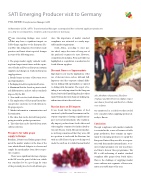
SATI Emerging Producer visit to GermanyPhiL boWeS Transformation Manager SATIIn November 2014, SATI’s Transformation Manager accompanied five selected applicant producers on a trip to see importers, retailers and researchers in Germany.Some interesting findings were noted that may have a significant impact on Table Grape suppliers to the European Un-ion (EU). The delegation observed key trade practices and learnt about expected changes in some of the following areas;1. The grape market supply calendar result- ing from longer transit times and the expan- sion of India and Peru as European Autumn suppliers and changes in Southern European supply patterns;2. Retail formats in terms of Discount stores and Supermarkets;3. Packaging trends for regular sized berries, 4. Maximum Residue Levels as private stand- ard differentiators, and not only as standards imposed by the EU;5. New tariff costs for South African Fruit; 6. The implications of European Union Rus- sian produce sanctions on South African ta- ble grape exports;7. Market information communication and dissemination;8. The value that can be derived from partici- pating in retailer product promotions.9. The value that can be derived from astute cultivar selection.Prospects for table grapesupply to EuropeBrazilian, Lebanese and Italian grapes domi- nated the market window at the time of the tour, which allowed delegates to observe and sample the merchandise from those respec- tive countries.There was a significant shortage of grapes in the EU over the period of the tour, which was considered to be a good sign for some of the potential prices for South African pro-duce. The importance of market standard compliance was reiterated as a rarely nego- tiable market requirement.South Africa, according to most par- ties asked, enjoys the status of being one of the preferred countries for taste. However, competition from India, Peru and Chile was highlighted as a significant consideration for South African suppliers.Discount Stores vs SupermarketsImportant to note was the implications of the rise of discount stores such as Aldi and Lidl. Importers cited the corporate cultural differ- ence in dealing with supermarkets as opposed to dealing with discounters. The aspect of re- tailing is not only important for the European Union, but for the United Kingdom also, where major German discount chains are making sig- nificant inroads into the retail sector.Russian bans on EU importsIt was found that the imposition of food sanctions by the Russian Government on Eu- ropean companies is having a significant im- pact on local intermediaries who tradition- ally import produce from South Africa and other supplier countries for further distribu- tion into Russia. South African intermediar- ies in Europe mentioned that they were still in a position to trade with the Russians, but with an added layer of paper work imposed under the said ban. A volatile Russian RoubelAlec Abrahams (Siyazama), Elize Boer (Osplaas) and Abie Pietersen (Alpha) inspect murchansie from Italy and Brazil at a Globus store in Bonn.was mentioned as a risk factor that needed to be considered when supplying product di- rectly to Russia.ConclusionThough compliance with market standards is essential in the course of business of table grape production, there remains an oppor- tunity for emerging producers to supply the European Union if they are able, in coopera- tion with their market intermediaries, to se- cure retail programmes one year in advance, and then to honour those programmes. The EU is still welcoming of market standard compliant table grapes from South Africa. Ours is the challenge of supplying market scarce cultivars into segments of lower satu- ration at a viable time of the year.MARKETING35 FEB | MARCH 2015


