


Page 66 - SA Fruit Journal VOLUME 14
P. 66
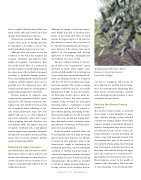
nity to complete the harvesting of their crop much sooner, with much lower risk of fruit spoilage from fungal disease infection.Whatever the speculated climate change scenario, there can be no denying that water for agriculture is becoming a scarcer com- modity and will raise input costs to growers.Although olives can survive in very dry conditions, it was found that irrigation has economic advantages and improves yield, quality and regularity of production. Over 90% of the world’s olive oil is produced in the drier countries around the Mediterranean Sea, where many of the orchards are managed according to traditional farming practices. Trees are generally planted extensively in arid conditions without irrigation and crops are generally poor. By comparison, most olive orchards in South Africa are recently planted, irrigated and managed more intensively.Modern methods of irrigation using computerised programmes, linked to capaci- tance probes and real time continuous data- loggers, long-term weather forecasts and the use of regulated deficit technology at spe- cific critical phenological stages have been applied with success on olives helping use water most efficiently, reduce water usage, reduce pumping time and electricity costs and maintain yields and improve fruit and oil quality. Combined with a well-planned fertiliser application programme, fertigation through such an irrigation system and foliar sprays when necessary, optimises nutrient uptake and allocation.[MN3]Reducing the labour headache – mechanisation, job creation or both? Harvesting of olives is labour intensive and this has some advantages in terms of local job creation. In many overseas countries it is no longer economically viable to harvest the old traditional orchards.Although the timing of olive harvesting is more flexible than that of deciduous fruit, labour of harvesting table olives by hand remains the biggest input cost. In order for this industry to survive, these costs have to be reduced by facilitating the harvesting ac- tions. However, if the arduous tasks can be replaced by jobs requiring skill, through application of technology, meaningful and more efficient jobs can be created.The most efficient method of harvest- ing oil olives is the “superintensive” system developed in Spain, which requires more capital and skill initially, but in the long run is more viable. Here specifically adapted cul- tivars and planting systems are integrated with the over-the-row modified wine grape harvesting machine. This system is gaining popularity worldwide and also successfully implemented locally. At present mechani- cal harvesting of table olives is under de- velopment in Europe and shows promise. Cultivars being developed for mechanical harvesting require a combination of many characteristics and need to be adapted to more efficient planting and training systems. These include smaller, less woody, low vigour trees, with softer growth and bearing habit, large, firm fruit resistant to bruising, ripen- ing uniformly, and having a low fruit remov- al force for easy detachment.In the meanwhile, until table olives can be mechanically harvested, hand harvesting must be made easier and more cost effective by improved olive genotypes. Each of the characteristics sought in combination for mechanical harvesting, can also individually contribute to facilitate hand harvesting. A cultivar development programme with these goals will therefore have both short and long term advantages. The possible use of trailed or self-driven picking /pruning platforms as is being assessed by the deciduous fruit in-dustry, may have advantages for table olive growers in the interim.Lower vigour genotypes resulting in trees with single or multiple central leaders and planted at high densities improve efficiency and production all round. Tree pruning then becomes a more regular, skilled, but less arduous task, since large saw cuts are eliminated. Such trees when mature, can to a large extent be mechanically pruned, while spraying of such trees with pesticides usingThe high quality Table Olive cultivar ‘ Kalamata’, shortly before harvest, Lemoendrif, Tulbagh.over-the-row equipment will become far more efficient, less wasteful and less harm- ful to the environment by eliminating drift. More disease resistant genotypes currently under development will contribute to more sustainable olive production.Reducing the alternate bearing tendencyThe modern orchard systems as described above entails a sound integration of geno- types, intensive planting system, early and continual tree training, regular selective light summer pruning, programmed fertigation linked to development stage and age of tree, and efficient pest and disease control. Al- ternate bearing is a survival mechanism. In nature or in poorly managed orchards, fruit development takes place at the expense of shoot growth. During spring, the developing fruit load competes with shoot growth on an increasing scale until the fruit get the upper hand. This results in no or very few sites be- ing available for flowering the next season. Floral initiation occurs by the middle of summer (end of December). This is the time of stone-hardening of the developing fruit-TECHNOLOGY 63 FEB | MARCH 2015


