


Page 64 - SA Fruit Journal VOLUME 14
P. 64
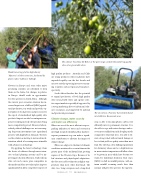
The cultivar ‘Nocellara del Belice’ at the green stage, used for flavourful top quality olive oil or green table olives.Hand harvesting of ultra-high density ‘Maurino’ oil olives onto nets, facilitated by plastic rakes. Oakhurst, Tulbagh.Growers in Europe and some other major producing countries are subsidised to keep them on the farms, but changes in policies in Europe should result in opportunities for olive growers in South Africa. Although the current poor economic situation has in- creased input costs of all local [MN1] agricul- tural production, our weak rand provides op- portunities to local growers and processors for the export of standardised high quality olive products. Imports are also becoming more ex- pensive resulting in local olive products being more competitively priced. However, labour- related political challenges are not encourag- ing long-term investments into agricultural projects with high labour demands. Growers see the solution as moving to increased mech- anisation, which is becoming more attainable with advances in technology.By applying the latest technology, from the choice of cultivars through more inten- sive orchard planting systems and by im- proving production efficiency, South African olive oil can be more price-competitive in the market and thus not only replace imports significantly but allow competitive exports ofhigh quality products. Australia and Chile are young producers whose industries have expanded rapidly over the last decade and are now actively exporting into new consum- ing countries such as Japan and Canada re- spectively.South Africa therefore has the potential to expand production of both high quality olive oil and table olives and capture selec- tive export markets especially if supported by a strong marketing drive to inform and edu- cate consumers, and supported by national and provincial government.Climate change, water scarcityand water use efficiencyOlives are one of the most efficient crops re- garding utilisation of water and conversion into high energy foodstuff and this hardy ev- ergreen permanent crop can make a signifi- cant contribution to alleviate the impact of climate change.Olives are adapted to the kind of climatic conditions envisioned to occur in future in the greater parts of the traditional fruit growing regions of the Western Cape. Because of its leaf structure and physiological adaptations, the olive tree is able to function at higher tem- peratures than most other fruit kinds. The olive tree, being evergreen and a long-livedThe oil cultivar, ‘Frantoio’ harvested by hand into bulk bins. Bonnievale area.crop, is able to fix atmospheric carbon very efficiently into its permanent structure. It is also able to cope with water shortages and re- cover more readily from such drought periods compared to other fruit trees. It is able to tol- erate strong winds without much damage or loss to fruit yields or quality easier than most fruit. The olive has a low chilling requirement for dormancy release and so a slight increase in mean winter temperature will allow olives to be grown in areas which have become too warm for traditional deciduous fruit crops. [MN2] A shift in rainfall patterns, with au- tumn rainfall occurring much later than normal, will give olive growers the opportu-TECHNOLOGY 61 FEB | MARCH 2015


