


Page 78 - SA Fruit Journal VOLUME 14
P. 78
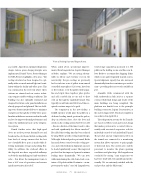
as possible. Apart from optimal refrigeration design, various green design principles were implemented. Daniel Visser, Project Manager for GEA Projects, highlights a few areas: “The roofing structure has been designed to opti- mally utilise as much natural light and venti- lation within the facility and office space. This was continued in the roof void where valves stations are situated and our service techni- cians require suitable working conditions. The building was also optimally orientated and designed for future solar panel installation as already proposed and planned. The two hold- ing stores feature insulated floors to minimise energy losses through the 1 500m2 floor space. Insulation thickness was increased in the walls and roof to improve thermal performance and reduce the infiltration loads on the refrigera- tion system.Daniel further notes that high-speed doors are used to prevent thermal losses and breaks in the cold chain. Mobile racking with four levels of storage ensures that the best use of available floor space is made while al- lowing maximum storage and packing flex- ibility. In addition, the overhead offices in the dispatch area have suspended walkways on both the marshalling yard and warehouse sides – this allows the management team to have a 360° view of operations and ensures quick intervention if needed”.View of docking bays and dispatch area.When asked about operational improve- ments, Hein Langenhoven, Logistic Manager at Betko, explains: “We are saving substan- tially on labour and overtime costs in the new facility. For pre-cooling, we previously had to stack two rows of pallets in an unused controlled atmosphere (CA) room, have four or five workers cover the pallets with tarpau- lins and staple these together, place probes and add a mobile fan at one end to draw cold air through the makeshift tunnel. This typically would take until 20:00 and thus re- quired overtime wages to be paid.“By comparison in the new facility, a forklift operator would place the pallets in a dedicated cooling tunnel, position the probes, drop an isolation sheet, close the door and switch on the cooling system by 13:00 or 14:00 – thus in a fraction of the time it used to take, and with significantly less labour involved.” He added that cooling time has been reduced by using GEA’s specific cooling tunnel design. With eight dedicated probes per tunnel, Betko has much better control over the cooling pro- cess, and cold sterilisation shipments can now be loaded significantly sooner. The improved product flow has improved general container loading times dramatically. “We can now, while maintaining the cold chain, load a con- tainer of 21 paletts within 15 minutes – an im- provement by miles,” says Mr Langenhoven.Cold storage capacity has increased to 2 600 pallets in the holding rooms, and this now al- lows Betko to accommodate shipping delays which occur quite frequently in peak season. Special shipment capacity has also increased dramatically from four containers per week to sixty – providing there are vessels available in port.Amandla Civils commenced with the bulk earthworks in July 2013 as a separate contract while final design and tender of the main buildings was being completed. The platform was handed over to the principle building contractor, Isipani Construction, at the end of August 2013. Practical completion was achieved in April 2014.The refrigeration systems for the Tunnels are based on GEA’s tried-and-tested design that makes provision for a control valve as- sembly with associated evaporator coils for individual control of each individual Tunnel. The product and air temperature probes in the tunnels are connected to a monitoring system that allows operators to print graphs of historical data. The system also enables personnel to monitor the plant operating conditions and plant trips. Mr Langenhoven concluded by saying: “Any snag-issues we had were dealt with very quickly and profes- sionally. We are extremely satisfied with the end-product and the GEA team”.ADVERTORIAL 75 FEB | MARCH 2015


