


Page 79 - SA Fruit Journal VOLUME 14
P. 79
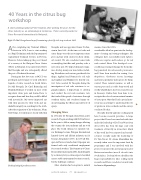
40 Years in the citrus bug workshopA short autobiography by Peter Stephen after working 40 years for the citrus industry as an entomological technician. Peter currently works for Citrus Research International in Nelspruit.Right: Dr Mal Georgala and myself examining a fruit fly stick trap in about 1985.After completing my National Military Service in 1974, I was to start working as a Pupil Technician with the Department of Agricultural Technical Services in Pretoria. However, before taking up the post, I heard of a vacancy at the Outspan Citrus Centre (OCC) in Nelspruit. I was interviewed by Dr Mal Georgala and was subsequently offered the post of Technical Assistant.During my first few years at OCC I was privileged and fortunate to work with three legends of citrus research in South Africa, Dr Mal Georgala, Dr Carel Buitendag and Hendrik Hofmeyr. I worked on most of the important citrus pests and learned how to recognise them and how they could be killed with insecticides. My tutors impressed me with their passion for their work and un- shakable integrity in searching for the truth. After the resignation of his technician, Johan Grobbelaar, I worked more closely with MalGeorgala and was appointed Senior Techni- cian in June 1981. At the time, red scale and citrus thrips were the most important citrus pests and my work centred on their chemi- cal control. We also conducted some trials on mealybug, fruit flies and powdery scale, a new citrus pest. We helped chemical compa- nies develop many new insecticides includ- ing Hostathion and various pyrethroids for thrips, Applaud and Nemesis for red scale and Agrilure and Hymlure for fruit fly con- trol. I also assisted Dr Georgala during the investigation of red scale resistance to or- ganophosphates. I helped him to develop and conduct the red scale resistance tests that tracked the spread of resistance through southern Africa, and conducted many tri- als investigating the efficacy and safety of oil sprays.Changing timesIn 1991 after Dr Georgala retired from active research, I began working with Dr Tim Grout. In the years to follow, many changes affecting the country, the citrus industry and me took place. The South African Co-operative Cit- rus Exchange became Outspan International Limited (1994) and all fruit industries in SA became deregulated (1997). In 1998 all Out- span staff were retrenched and Capespan was formed with only conditional employment for research workers. The formation of Citrus Research International in 2001, funded largely by a statutory levy on citrus exports, heralded a more stable environment for citrus research, but the challenges continue.More attention has been given to natural SA VRUGTE JOERNAAL 76 FEB | MAART 2015enemies. Since the 1980’s,considerable effort has gone into the develop- ment of rearing and testing techniques. My colleagues have successfully reared Aphytis, Chilocorus nigritus and Lindorus sp. for red scale control. Bruce Tate developed a suc- cessful mass rearing technique for the mealy- bug parasitoid Coccidoxenoides perminutus, and I have been involved in rearing Orius thripoborus, Goetheana incerta, lacewings and various predatory mite species for thrips control. These natural enemies, as well as various pests such as coffee bean weevil and woolly whitefly have also been reared for use in bioassays. Studies have been done to in- vestigate the roles of various natural enemies of citrus pests. One that I had a special inter- est in was an attempt to understand the role of spiders in citrus orchards and the surveys conducted for this.Recently fruit fly and false codling moth have become research priorities. A large project that I have been involved with, first under the leadership of Dr Tony Ware from about 2001, has been the large scale cold treatment of fruit fly in citrus fruit. Much of this work has been repeated and extend- ed more recently under the leadership of Dr Tim Grout. Dr Aruna Manrakhan has recently taken over the important fruit fly programme and I was involved with her project to monitor the arrival and spread of Bactrocera invadens (now B. dorsalis) into South Africa. Dr Sean Moore shoulders the huge responsibility for false codling moth research and I have conducted several trials for him in Mpumalanga.Feeding laelapid predatory mites.


