


Page 45 - SA Fruit Journal VOLUME 14
P. 45
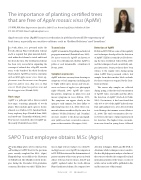
The importance of planting certified trees that are free of Apple mosaic virus (ApMV)SS Malan Plant Improvement Specialist, SAPO Trust, Private bag X5023, Stellenbosch 7599. Tel: 021 887 6823; Email: sophia@saplant.co.zaApple mosaic virus (apMV) causes a reduction in yield and overall life-expectancy of fruit trees, especially on sensitive cultivars such as ‘Golden Delicious’ and ‘Jonathan’.In South Africa, it is governed under the South African Plant Certification Scheme and it is required that plant material distrib-uted within the Scheme be tested and found free from the virus. The Certification Scheme has been very successful in expanding the coverage of orchards free of ApMV over the years, to the benefit of the whole deciduous fruit industry. ApMV has various synonyms such as Mild apple mosaic virus, Severe ap- ple mosaic virus, Rose mosaic virus, European plum line pattern virus, Hop virus A, Hop virus C, Dutch plum line pattern virus and Birch ringspot virus (Petrzik, 2005).Host rangeApMV is a pathogen with a diverse natural host-range consisting primarily of woody plants. Hosts include apple, apricot, cherry, almond, rose (Fulton, 1972), hazelnut, black- berry, raspberry, hops (Petrzik & Lenz, 2002) and strawberry (Tzanetakis & Martin, 2005). Pear was not considered a host of ApMV un- til recently (Petrzik & Lenz, 2002).TransmissionApMV is transmitted by grafting and infected propagation material (Petrzik & Lenz, 2002). No insect vectors for ApMV are known to occur. It is still unknown whether ApMV is pollen or seed transmissible (Aramburu & Rovira, 2000).Symptom expressionApMV infection can vary from showing no symptoms to leaf symptoms including pale to bright yellow spots, mosaic and vein ne- crosis on leaves of apples (see photograph right) (Nemeth, 1986). ApMV also causes line-pattern symptoms in plum trees and mosaic symptoms in roses (Fulton, 1972). The symptoms can appear clearly in late spring to early summer, but later diffuse to mild symptoms (Lee et al., 2002). Most com- mercial cultivars are affected by the virus, but cultivars ‘Golden Delicious’ and ‘Jonathan’ are more sensitive to the disease and signifi- cant yield losses have occurred in some re- gions on these varieties (Desvignes, 1999).Detection of ApMVELISA and RT-PCR are some of the regularly used techniques developed for the detection of ApMV. ELISA is routinely used for detect- ing the virus worldwide (Choi & Ryu, 2003) and the technique is based on antibody-anti- gen interaction. Some producers have been witness to the regular visits during spring when SAPO Trust personnel collects leaf samples from their mother block orchards for these routine tests required by the Certi- fication Scheme.The reason why samples are collected during spring, is that the viral concentration of ApMV varies seasonally and this affects the detection of ApMV (Svoboda & Polak, 2010). For instance, it has been found that only 10% to 13% of the ApMV infected stone fruit and hazelnut trees, were detected when tested during a hot summer season (Matic et al., 2008). The viral concentration also var- ies between the types of plant material used for detection. The highest virus concentra- tions were found in young leaves, followedSAPO Trust employee obtains M.Sc (Agric)Sophia Malan (photo above), who has been working at SAPO Trust for the past nine years, recently completed her M.Sc. (Agric)Plantpathology successfully at the University of Stellenbosch. She officially received her de- gree during the December 2014 graduation ceremony. Her thesis was titled “ELISA detec-tion of Apple chlorotic leafspot virus (ACLSV) and Apple mosaic virus (ApMV) in comparison to RT-PCR detection and the determination of genetic variation of these virus species in South Africa”. It focused on two viruses, ACLSV and ApMV, regulated under the South African Plant Certification Scheme. She compared twodetection techniques, ELISA and RT-PCR, to determine which technique is most sensitive. She also did phylogenetic analyses of isolates of these viruses whereby she compared local and international isolates of the viruses. A series of articles on her results will be published in this and the next issue of this journal.TEGNOLOGIE 42 FEB | MAART 2015


