


Page 46 - SA Fruit Journal VOLUME 14
P. 46
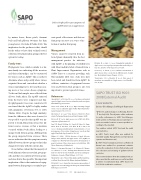
by mature leaves, flower petals, dormant buds and bark phloem (80 times less than young leaves) (Svoboda & Polak, 2010). The implication for the producer is that, should he/she wishes to have their orchards tested, collection of leaf material in spring is the best option for testing.Family treesPhylogenetic trees, which is similar to a hu- man family tree indicating all the ancestors and their relationships, can be constructed for viruses such as ApMV. This is useful to determine where and possibly when, viruses originated from and can indicate whether a virus is mutating fast or slow and thus caus- ing more or less severe disease symptoms. To this end leaf samples were collected from all over South Africa. The ApMV extracted from the leaves were compared and fam- ily (phylogenetic) trees were constructed. It was found that the ApMV is highly similar with similarities of between 96% to 100% (Malan, 2014). Despite the high similarity, from the differences that were observed, it was possible to predict that ApMV was im- ported to South Africa from at least two dif- ferent sources overseas or that a mutation occurred within South Africa, leading to a unique South African group, differing from the group imported from overseas. There was no indication that the symptom severity differed between the two groups or that it has changed over time with the current data.It was further evident that the majority of South African isolates are not fruit group spe- cific and that cross-infection between pome- and stone fruit is thus possible. The important implication of this is that sanitation of equip- ment between fruit groups is essential to pre-Pale to bright yellow spot symptoms of ApMV infection on apple leaves.vent spread of the viruses and that one fruit group can serve as a source of in- fection of another fruit group.ManagementViruses cannot be removed from in- fected plants chemically, thus the best management practice for infectionwith ApMV, is the planting of certified trees with blue/candidate labels obtained from a Plant Improvement Organization such as SAPO Trust or a nursery providing such blue/candidate label trees. Such trees have been tested and found free from ApMV. In addition, sanitation of equipment between trees and between fruit groups is also very important to prevent spread of viruses.ReferencesAramburu, J., & Rovira, M. (2000). Incidence and natural spread of Apple mosaic ilarvirus in hazel in north-east Spain. Plant Pathology, 49, 423-427.Choi, A. H., & Ryu, K. H. (2003). Rapic screening of Apple mosaic virus in cultivated apples by RT-PCR. Plant Patho- logical Journal, 19(3), 159-161.Desvignes, J. C. (1999). Virus diseases of fruit trees. Paris: Centre Technique Interprofession Fruits Légumes (Ctifl).Fulton, R. W. (1972). Apple mosaic virus. C.M.I./A.A.B. De- scriptions of plant viruses, 83.Lee, G. P., Ryu, K. H., Kim, C. S., Lee, D. W., Kim, J. S., Park, M. H., Noh, Y. M., Choi, S. H., Han, D. H., & Lee, C. H. (2002). Cloning and phylogenetic characterization of coat protein genes of two isolates of Apple mosaic virus from 'Fuji' apple. Plant Pathology Journal, 18, 259-265.Malan, S.S. (2014). ELISA detection of Apple chlorotic leafspot virus (ACLSV) and Apple mosaic virus (ApMV) in comparison to RT-PCR detection and the determination of genetic variation of these virus species in South Africa. MSc Thesis. University of Stellenbosch.Matic, S., Sanchez-Navarro, J. A., Mandic, B., Myrta, A., & Pallas, V. (2008). Tracking three ilarviruses in stone fruit trees throut the year by ELISA and tissue-printing hy- bridization. Journal of Plant Pathlogy, 1, 137-141.Nemeth, M. (1986). Viruses, Mycoplasma and Ricetsia Diseas- es of Fruit Trees. Boston, USA: Kluwer Academic Publishers.Petrzik, K. (2005). Capsid protein sequence gene analysis of Apple mosaic virus infecting pears. European Journal of Plant Pathology, 111, 355-360.Petrzik, K., & Lenz, O. (2002). Remarkable variability of Apple mosaic virus capsid protein gene after nucleotide posi- tion 141. Archives of Virology, 147, 1275-1285.Svoboda, J. &. Polak, J. (2010). Relative concentration of Apple mosaic virus coat protein in different parts of apple tree. Horticultural Science (Prague), 1, 22-26.Tzanetakis, I. E., & Martin, R. (2005). First report of strawberry as a natural host of Apple mosaic virus. Plant Dis- ease, 89, 431.TECHNOLOGY 43 FEB | MARCH 2015SAPO TRUST ISO 9001: 2008 External AuditF G H Van ZylBusiness Unit Manager, Pathology & RegistrationThe ISO audit took place on Monday, Novem- ber 3rd, 2014. The objective of the audit was to verify conformance to SAPO Trust Manage- ment system on Fleurbaix and associated proce- dures at outside locations as were specified ac- cording to the standard.Two auditors visited SAPO Trust and the audit was twofold i.e.:a. SAPO Trust's head office was audited for Standard Quality Management and Operational systems and functions and,b. SAPO Trust foundation premises at Riebeeck Kasteel was audited for operational activities such as the evaluation of stone fruit varieties and the collection and checking of graftwood from such sites.The recommendation from this audit by both au- ditors was that the audit was successful and that it will be recommended that SAPO Trust's ISO 9001:2008 certification continues.


