


Page 60 - SA Fruit Journal VOLUME 14
P. 60
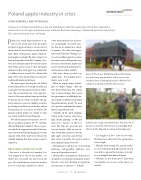
Poland apple industry in crisisHuGH CaMPBEll anD PEtEr DallA group of six intrepid South Africans and one Zimbabwean under the leadership of Peter Dall, undertook a technical tour to the apple production areas of Poland, Bodensee (Germany), Switzerland and South Tyrol (Italy). This article will mostly focus on Poland.Poland, the fourth largest producer of ap- ples in the world and by far the largest producer of apples in Europe, was in a state ofshock when we arrived there in early October 2014. Many of the growers had lost their pri- mary market overnight. The ban on imports of fruit and vegetables from EU Countries, Nor- way and Australia imposed by Russia meant that Polish growers had to find alternative markets for their 2014 apple crop estimated at 3,5 million tons as around 70% of their fresh apples (50% of the production processed) were traditionally marketed in Russia.The main apple growing area in Poland around Skierniewice is basically very flat and is a patchwork of production blocks of 10 hec- tares. The average farm size of an apple pro- ducer is 10 hectares with no farms greater than 50 hectares in size. About one third of the ap- ple production is seen to be highly productive producing around 80 tons per hectare with an average fruit size of in excess of 80 mm. The general orchard design was similar to what one saw in South Tyrol and Germany.We visited numerous brand-new, state-of- the-art packsheds paid for by 75% subsidies (EU and Polish Government). These coopera- tive packsheds supported around 350 hectares of production and had packaging and storage capacity (with DCA) way beyond the present demand implying that there is huge scope for expansion.Observations and lessons learnt• One needs to diversify one's markets. It is very dangerous to rely on one market – no matter how successful one has been in the past. In a South African context, the need for access to a diversity of markets is critical.• One must plant the best and new- est commercially successful varie- ties that are in demand in a variety of markets. We visited the biggest nursery in Poland producing in ex- cess of one million apple trees where the main varieties being made were focused on the Russian market and are not varieties demanded in West- ern Europe and other markets.• One must always produce top quality fruit. Good quality fruit is always easier to sell.• Often we require major catastro- phes to catalyse change. After the 1987 freeze Poland lost 30% of their trees to winter damage. This created the opportunity to establish high den- sity orchards on M9 Rootstock which helped the industry greatly. We need to be proactive and make the changes that are required timeously.Pieter de Wet, Larry Whitfield and Peter Dall outside one of the many new packsheds with extensive cold storage facilities including DCA built in Poland (75% subsidy from the EU and Polish Government).• Virtually all the apple plantingsviewed in the countries visited werehigh density plantings (3 000 andmore trees / hectare) on M9 root- Adam Lajitjé, a large scale Polish farmer who farms on 50 stock. The fruit size, precocity and ha and vice president of the Coop in a young apple block. tree size benefits of M9 are very evi- Christo de Wet diligently recording in the background. dent. South Africa needs to select theright apple rootstocks and developthese as fast as possible. We need to select no more than three main rootstocks.• Mechanisation and the use of harvesting platforms. Self-propelled platforms were seen on all operations visited.• Orchard floor management. Orchards are designed to accommodate machinery and are therefore very level allowing for platforms and spray rigs to spray at 8 – 10 km/h.• Tree height is at 100 – 120% of row width. Platforms have allowed for the optimisation of tree height.• Hail and shade netting. The general trend is to cover orchards for hail. All structures viewed were able to open and the structures were rath- er over-designed than under-designed.• Subsidies are not always good. They often overcapitalise in one area at the expense of another.TECHNOLOGY 57 FEB | MARCH 2015


