


Page 62 - SA Fruit Journal VOLUME 14
P. 62
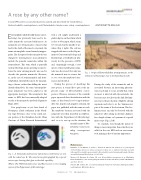
A rose by any other name?A new EPN and its associated bacteria named and described for South Africa: Heterorhabditis noenieputensis and Photorhabdus luminescens subsp. noenieputensisantOinEttE MalanEntomophilic, which literally means ‘insect- loving’, has previously been used to de- scribe nematodes associated with insects. Asnematodes are often parasites of insects that lead to the death of the insects concerned, the name entomophilic seems bizarrely inappro- priate. The descriptor for these nematodes was changed to ‘entomogenous’, in an attempt to include the parasitic nematodes within the nomenclature. This term, which is generally used in Mycology, means ‘growing on insects’. Later, the term ‘entomoparasitic’ was used to describe the parasitic nematodes. However, as, in the case of steinernematids and heter- orhabditids, they kill the insect by transmit- ting a disease, rather than killing the insect directly themselves, the term ‘entomopatho- genic nematodes’ has been adopted as the appropriate descriptor. The acronym for this name, i.e. EPN, has been universally adopted to refer to the nematodes involved (Nguyen & Hunt, 2007).Few people may, as yet, have heard of Noenieput, a little settlement in the North- ern Cape Province, close to the south-east- ern portion of the Namibian border. Elma Carstens, of Citrus Research International,took a soil sample underneath a garden fig tree on their farm which is close to Noenieput, which seems to be located in the middle of no- where (Fig. 1 right). The soil was trapped with insects at the Depart- ment of Conservation Ecology and Entomology at Stellenbosch Uni- versity for the presence of EPN, and, surprisingly enough, a new species of insect pathogenic nema- tode was discovered. Not only was the nematode new to science, but so, too, were the symbiotic bacte- ria associated with it.Fig. 1. Origin of Heterorhabditis noenieputensis, at the settlement of Noenieput close to the Namibian border.During the process of describing this new species, it seemed fit to give it the im- pressive name of Heterorhabditis noenie- putensis. Overseas reviewers of the scientific paper expressed their dissatisfaction with the name, as they found it to be unpronounce- able, but, despite such negative criticism, the paper was published with the name as such. The symbiotic bacteria associated with the nematode were then described in collabora- tion with the Department of Microbiology, and, so as to ease up on the situation, theDuring the study of the nematode and its associated bacteria, an interesting phenom- enon was found to occur, notably that, when an insect is infected with the nematode, the bacteria cause it to glow in the dark. Biolumi- nescence is the production of light by a living organism and refer to in the ‘luminescens’ part of the name of the bacterium. This bio- luminescence can only be observed with the naked eye after sitting in absolute darkness for a length of time, or by means of a special microscope (Fig. 2, left).To conclude, even though the nature of things is more important than what they are called, in the case EPN and our new nema- tode, naming is also of extreme importance.scientific name of Pho- torhabdus luminescens subsp. noenieputensis was given.ReferencesFig. 2. A. Nematode and bacteria infected wax moth larvae as seen with the naked eye. B. The same larvae photographed by a special microscope, showing their glow in the dark capability.(Photo: The IVIS bioluminescence and fluorescence in vivo imaging system of the Department of Microbiology).Ferreira, T., Van Reenen, C., Pagès, S., Tailliez, P., Malan, A.P., & Dicks, L. 2013. Description of Photorhabdus luminescens subsp. noenieputensis subsp. nov., a symbiotic bacterium associated with a new Heterorhabditis species related to Heterorhabditis indica. International Journal of System- atic and Evolutionary Microbiology, 63: 1853-1858.Malan, A.P., Knoetze, R. & Tiedt, L.R. 2014. Heterorhabditis noenieputensis n. sp. (Rhabditida: Heterorhabditidae), a new entomopathogenic nematode from South Africa. Journal of Helminthol- ogy, 88(2): 138-151.Nguyen, K.B. & Hunt, D.J. 2007. Entomopathogenic Nematodes: Systematics, Phylogeny and Bac- terial Symbionts. Brill Leiden-Boston.TECHNOLOGY59 FEB | MARCH 2015


