


Page 63 - SA Fruit Journal VOLUME 14
P. 63
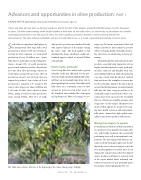
Advances and opportunities in olive production: PART 1CarlO COSta ARC Infruitec-Nietvoorbij, Stellenbosch | costac@arc.agric.zaOlives and olive oil have been an integral and basic part of the diet of the peoples around the Mediterranean Sea for thousands of years. A better understanding of the health benefits of both olive oil and table olives, as attested by an abundance of scientific and popular publications over the past 25 years, has led to growing consumer awareness and increasing demand forolive products. The olive industry worldwide and also in South Africa has, as a result, expanded dramatically in recent years.South Africa is currently a small player on the international olive stage, with a total production of about 10 000 tons of fresh ol-ive fruit in 2013 compared to a total world production of over 15 million tons. Spain, Italy, Greece and Turkey are the leading pro- ducers. Around 90% of world production goes towards extraction of olive oil and about 10% into table olive processing, whereas in South Africa around 60% goes into olive oil production. About 6 tons of fresh olives are required to produce 1 ton of olive oil. Local production is estimated to be around 1 000 tons of olive oil per year valued at R50m and 3 000 tons of table olives valued at about R50m, giving a total local olive production value around R100m. Over 95% of SouthAfrican olive production is marketed locally with exports only just at the initial “testing the water” stage. The local market is still dominated by cheap, subsidised, usually sub- standard imports valued at around R100m sold annually.Food security and healthA food crop like olives which can be grown relatively easily and efficiently for the pro- duction of high energy and high health value, will have an increasingly important role to play regarding food security. Naturally cured table olives are a convenient source of olive oil and are in fact an even richer source of the beneficial anti-oxidants like oleuropein and hydoxytrosol. Olive oil contains on av-erage over 70% mono-unsaturated oleic acid which is known to have numerous positive effects on human health. Naturally cured ta- ble olives have an additional pro-biotic ad- vantage.The health and flavour benefits from olive products, especially extra virgin olive oil, are largely derived from fresh, sound, good qual- ity fruit, extracted and handled with care, and sold while still fresh, while oil made from over-ripe, rancid, fruit-fly infested, oxidised fruit, and stored for a number of seasons, has lost those benefits. Much of the oil produced around the Mediterranean Sea unfortunately falls into the latter category and has to be chemically refined and blended. Once con- sumers have been exposed to the wonderful flavours of fresh, good quality, genuine extra virgin olive oil the cheaper alternatives lose much of their appeal. As people are becom- ing more health conscious and environmen- tally aware, demand for high quality natu- rally produced olive products will increase.Moving from imports to exportsSouth Africa has built an excellent reputation as a producer of top quality extra virgin olive oils, with locally produced oils consistently performing very well in international com- petitions. The discerning South African con- sumer is slowly learning to appreciate the fact that in the case of olive oil, cheapest is not the best and that quality costs a little more. Local demand for such products is however limited and so producers will have to seriously look at the export market where informed con- sumers are prepared to pay premium prices for genuine, fresh, high quality olive oil.The Table olive cultivar ‘Mission’ at the beginning of the colour change stage, Tulbagh.TEGNOLOGIE 60 FEB | MAART 2015


